Path lights are usually the first fixtures a homeowner thinks about and the ones most often installed badly. Put them too close together and the front walk looks like an airport runway. Space them too far apart and you walk from bright pool to dark gap to bright pool again. The right spacing is not a single number. It depends on the fixture, the path and what else is lit nearby.
The quick answer
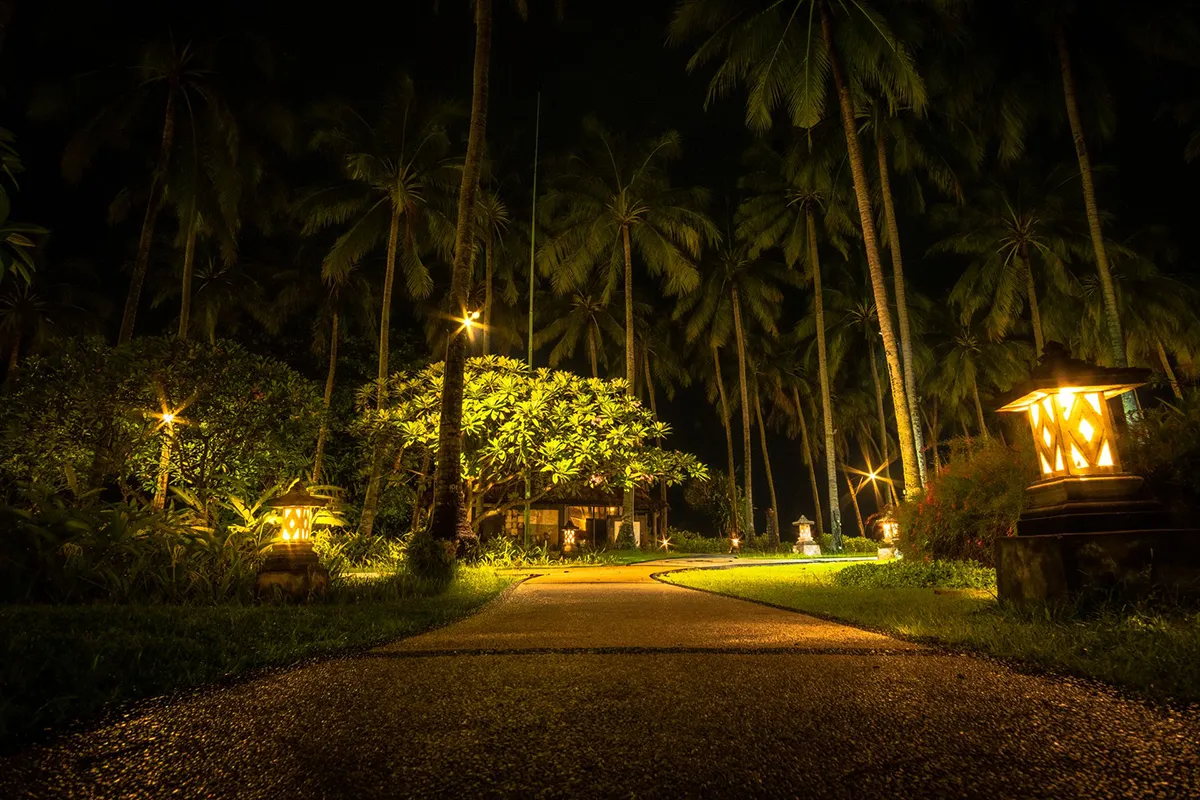
For most residential walkways, path lights are spaced roughly 6 to 10 feet apart, measured along the path. On a walk that is lit from both sides, fixtures are usually staggered so each one sits opposite a gap on the other side. On a narrower walk lit from one side only, spacing tends toward the shorter end of that range.
The goal is overlapping or nearly touching pools of light on the walking surface, not continuous brightness. Small soft gaps between pools are fine and often look better than perfectly even coverage.
Spacing guide
| Situation | Typical spacing | Notes |
|---|---|---|
| Front walk, 3 to 4 ft wide, one side | 6 to 8 ft | Place on the planting-bed side so fixtures read as part of the garden |
| Front walk, both sides, staggered | 8 to 10 ft per side | Gives a light pool every 4 to 5 ft along the walk |
| Garden path, stepping stones | 8 to 12 ft | Softer and sparser; light the turns and changes in level |
| Driveway edge | 12 to 20 ft | Mark the edge rather than flood the slab; consider moonlighting instead |
| Steps | Every step or every other step | Riser or wall lights, or a path light at top and bottom |
| Side yard or utility path | 10 to 15 ft | Function first; keep output low to avoid lighting neighbors' windows |
These ranges are a starting point. The fixture's beam spread and mounting height change everything, which is why a designer will often test-place fixtures at night before committing.
What changes the spacing
Fixture height
Most path lights stand about 16 to 24 inches tall. A taller fixture throws a wider pool, so it can be spaced farther apart. A short 12-inch fixture produces a tighter pool and needs closer spacing. Height should also suit the plantings. In Spring, where liriope, Asian jasmine and St. Augustine edges grow fast, a fixture that is too short disappears into the foliage within a season.
Beam spread and hat size
Path lights with a wide hat spread light in a circle, often 8 to 12 feet across. Fixtures with a directional or asymmetrical spread push more light onto the path and less into the bed. Read the manufacturer's photometric data if it is available, since two fixtures with the same wattage can cast very different pools.
Brightness
Path lighting needs far less light than most people assume. A fixture in the range of roughly 100 to 200 lumens, often 2 to 4 watts of LED, is plenty for a walkway. Brighter fixtures do not let you space wider in a pleasant way. They just create glare and hot spots.
Ambient light
If the walk already gets spill from moonlighting in an oak, a lit facade or a porch light, you need fewer path lights. Good designs treat path lighting as one layer, not the whole plan.
Avoiding the runway look
The runway effect happens when identical fixtures march in straight, evenly spaced rows down both sides of a walk. It looks mechanical and draws the eye to the fixtures rather than the path.
- Stagger instead of pairing. Alternate sides so no two fixtures sit directly across from each other.
- Vary the rhythm slightly. Let spacing flex with the plantings, a little closer at a curve, a little wider on a straight run.
- Set fixtures into the beds. Place them among plants rather than right at the edge of the concrete.
- Light destinations, not just the route. Emphasize the entry, a bench or a turn, and let the path read between them.
- Use fewer, better fixtures. Two well-placed lights often do more than five evenly spaced ones.
A path should feel discovered, not announced.
Curves, edges and steps
Curves: Place a fixture on the outside of each bend, where it lights the turn and guides the eye. Inside corners rarely need one.
Distance from the path edge: Set most path lights about 12 to 18 inches back from the walking surface. Closer and they become trip hazards and targets for mowers and edgers. Farther back and too much light falls into the bed.
Steps: Changes in level are where lighting matters most for safety. Riser lights, lights under a cap stone or wall-mounted step lights are the cleanest solutions. If those are not practical, place a path light at the top and bottom of the steps so both landings are clearly visible.
Driveways
Driveways are wide and long, so lining them with path lights rarely looks right and can easily turn into the runway problem at a much larger scale. Better options include:
- Marking the entrance and the curve of the drive with a few fixtures rather than a full row.
- Moonlighting from trees near the drive, which lights the surface softly and naturally.
- Low-profile in-grade or brick-paver lights along the edge, used sparingly.
- Lighting the landscape beside the drive so the edge is defined by what surrounds it.
Our pathway and driveway lighting service covers these approaches in more depth, and the home security lighting guide explains how path and drive lighting supports safety without glare.
Planning the circuit
Path lights are low-wattage, but a long walk with a dozen fixtures still needs proper wire sizing to avoid voltage drop at the far end, where dim fixtures make spacing look uneven. Run the math with our transformer sizing calculator, or estimate the overall layout with the fixture estimator. If your existing path lights are dim, uneven or tilted, our repair team can reset and rebalance them.
At Spring Landscape Lighting we treat path lighting as one layer in a larger plan, so the walk feels connected to the house, trees and garden around it.
Frequently asked questions
How far apart should path lights be?
Most residential path lights are spaced about 6 to 10 feet apart along the path. On walks lit from both sides, fixtures are usually staggered so each one sits opposite a gap on the other side.
Should path lights go on one side or both sides?
Narrow walks often look best lit from one side, usually the planting-bed side. Wider walks can use both sides, but staggering the fixtures avoids the runway look.
How bright should path lights be?
Path lights need relatively little light. Roughly 100 to 200 lumens per fixture, often 2 to 4 watts of LED, is enough for most walkways without causing glare.
How far from the walkway should path lights be placed?
About 12 to 18 inches back from the edge of the path is typical. That keeps them out of the way of feet, mowers and edgers while still putting light on the walking surface.
Do I need path lights along my driveway?
Not usually along the full length. Marking the entrance and curves, moonlighting from nearby trees or using a few low-profile edge lights tends to look better than a continuous row of fixtures.

Spring Landscape Lighting
Landscape lighting designers serving Spring, Klein, The Woodlands and North Houston. Questions about your property? Get in touch.